How Long Does Stump Grinding Take in Hamilton, MT?
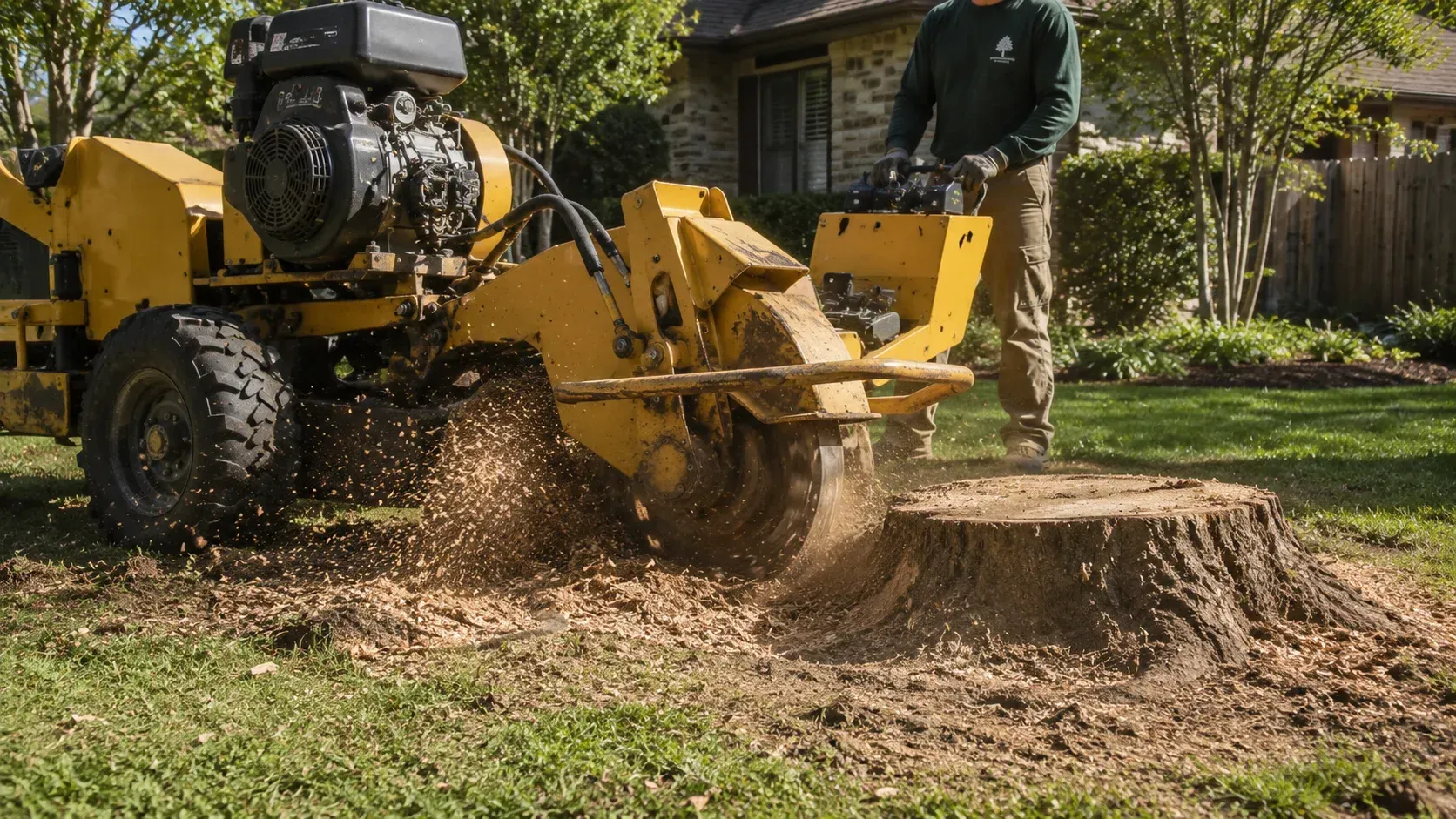
Table of Contents
- How Long Stump Grinding Takes in Hamilton, MT
- What Happens During a Stump Grinding Service
- Factors That Affect Stump Grinding Time in the Bitterroot Valley
- A Timeline Framework for Estimating Your Stump Grinding Project
- Common Misconceptions About Stump Grinding Duration
- Real Hamilton Stump Grinding Timelines: Three Property Scenarios
- What Typical Stump Grinding Advice Gets Wrong
- Seasonal and Site Factors That Affect Stump Grinding in Montana
- Conclusion: Planning Your Stump Grinding Project
- Schedule Stump Grinding in Hamilton, MT
- Frequently Asked Questions
Key Takeaways
- Most residential stumps in Hamilton, MT take 15 minutes to 2 hours to grind, depending on diameter, root depth, soil conditions, and wood hardness.
- Grinding is only part of the job. Site setup, root management, and debris cleanup usually add more time than the grinding itself.
- Multiple stumps on one property do not add time in a straight line. Efficiency gains from a single equipment setup often reduce the time spent per stump.
- Old, partially decayed stumps grind faster than fresh, solid ones because the wood offers less resistance to the grinding wheel.
- A realistic total project window for a single residential stump in the Bitterroot Valley runs 60 minutes to 3 hours, not the 15 to 30 minutes many online sources quote.
How Long Stump Grinding Takes in Hamilton, MT
A typical residential stump takes 15 minutes to 2 hours to grind, with most falling between 30 and 90 minutes. The full project, including site setup, grinding, and debris cleanup, generally runs 60 minutes to 3 hours.
Property owners in Hamilton and across the Bitterroot Valley asking how long stump grinding takes usually want a number they can plan a day around. The grinding itself is often the fastest part of the visit. Stump diameter, root depth, soil type, wood hardness, and how much cleanup you want are what actually decide whether a crew is on your property for 30 minutes or most of an afternoon.
A small stump around 8 inches across with shallow roots in soft soil can be ground down in 15 to 20 minutes. A large stump around 24 inches across with deep, hard roots in clay soil can take 90 minutes to 2 hours to grind. Add setup, root work, and site cleanup, and total time on-site typically lands between 2.5 and 4 hours for a single large stump.
Knowing the difference between grinding time and total project time is what lets you plan your schedule accurately instead of guessing based on a number that only describes part of the work.
What Happens During a Stump Grinding Service
Stump grinding is not a single action. A professional visit moves through several stages, and each one adds time on top of the grinding itself.
Site Assessment and Equipment Setup (5 to 10 minutes)
A crew evaluates stump size, checks for nearby hazards such as power lines, structures, or sprinkler lines, and positions the grinder. They also check whether roots spread beyond the visible stump, since that affects both the approach and the total time required.
Grinding the Stump Down (Time Varies Most Here)
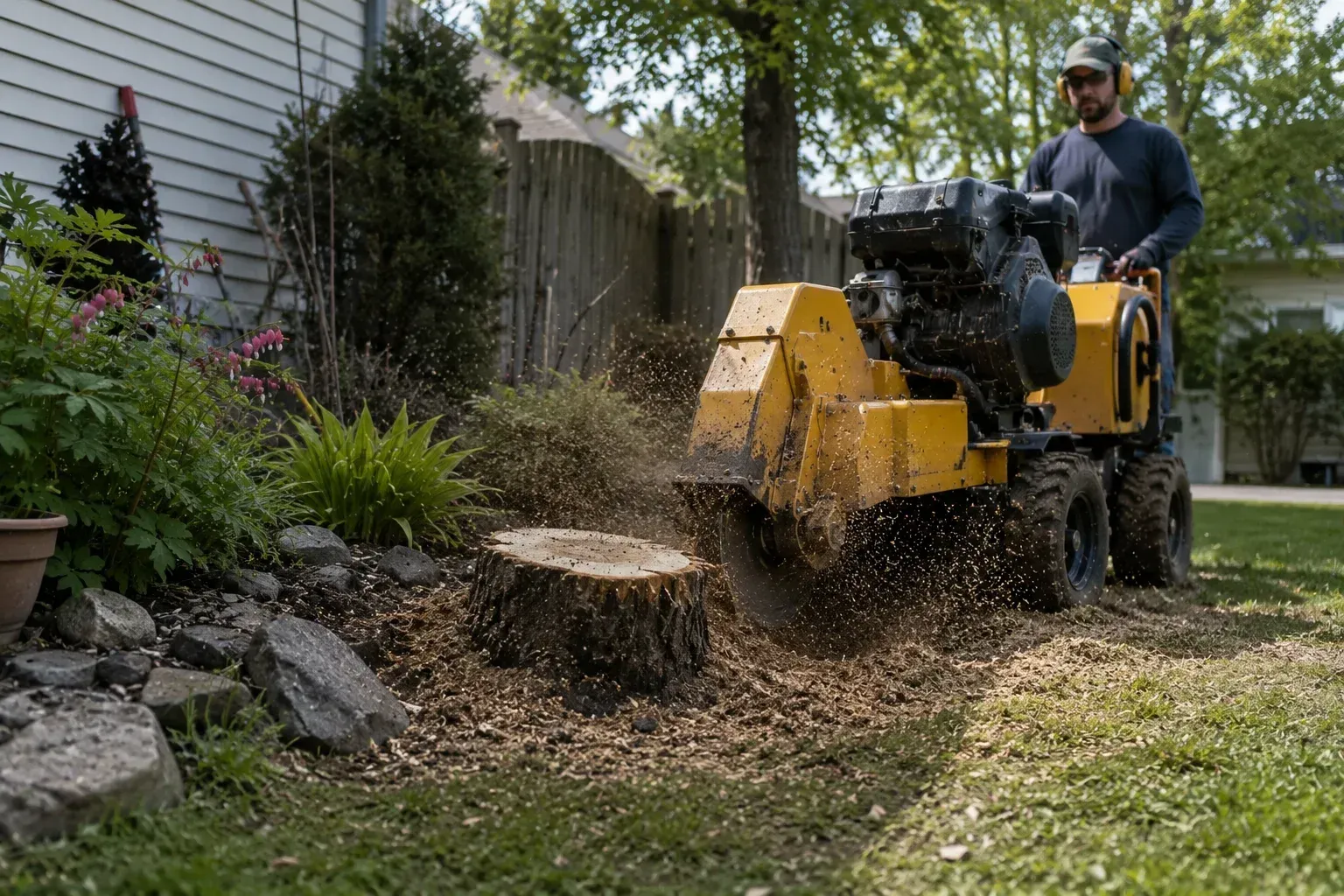
A grinding wheel with carbide teeth rotates into the stump at high speed, working from one side to the other until the wood is reduced below ground level. This stage is where stump diameter and wood hardness matter most, and it accounts for most of the variation between a quick job and a long one.
Addressing the Root System (Time Varies)
Once the visible stump is down, roots extending outward often still need attention. Some homeowners want the stump ground 8 to 12 inches below the surface so grass can grow over it. Others want deeper grinding to remove a tripping hazard entirely, or roots pulled rather than ground. Each option changes the time required.
Debris Management and Cleanup (10 to 30 minutes)
Grinding produces a substantial volume of wood chips. Handling that debris, whether it is pushed back into the hole, spread across the yard, or hauled away, along with raking the site to a finished condition, is real work that is frequently left out of online time estimates.
Factors That Affect Stump Grinding Time in the Bitterroot Valley
Stump Diameter Is the Primary Factor
Diameter has the single largest effect on grinding time. A 6-inch stump usually takes 15 to 20 minutes. A 12-inch stump runs 30 to 45 minutes. A 24-inch stump can take 90 minutes to 2 hours. The relationship is not a straight line, because a larger diameter means exponentially more wood volume to process, not just a proportionally larger stump.
Root Depth and Spread
Roots extending 12 to 18 inches below the surface require more grinding than shallow root systems. Roots that spread widely beyond the visible stump increase the total area that needs work, especially when they extend toward structures or fence lines.
Wood Species and Hardness
Hardwoods such as oak and maple resist the grinding wheel more than softwoods such as pine or aspen. A mature hardwood stump can take roughly 50 percent longer to grind than a softwood stump of similar diameter.
Soil Type and Moisture
Clay-heavy soil common in parts of the Bitterroot Valley slows equipment movement and debris handling, and wet soil compounds that effect. Sandy or loamy soil is easier to work in. Most jobs proceed at a normal pace in moderate soil conditions.
Stump Health and Decay
An older, partially rotted stump often grinds faster than a fresh one, because decayed wood offers less resistance. A fresh, solid stump requires more force from the grinding wheel and takes longer to process, which is the opposite of what many people assume.
Equipment Access
A grinder positioned close to the stump with clear maneuvering room works faster than one that must be repositioned repeatedly around gates, fencing, or landscaping. Limited access can add meaningful time to a job that would otherwise be quick.
Cleanup Scope
Minimal cleanup might add about 10 minutes. Full site raking and restoration can add 30 to 45 minutes. This is a choice you make with your contractor, and it directly affects total project length.
A Timeline Framework for Estimating Your Stump Grinding Project
Rather than relying on a single generic number, this framework walks through the variables that determine your actual timeline.
Step 1: Identify Your Stump's Characteristics
- Measure the stump diameter at ground level.
- Note whether the wood looks healthy or already decayed.
- Observe how far roots spread around the base.
- Check whether the soil is wet, dry, or moderate.
Step 2: Estimate Grinding Duration
| Stump Profile | Estimated Grinding Time |
|---|---|
| 6-10 inch diameter, soft wood, shallow roots | 15 to 30 minutes |
| 10-16 inch diameter, mixed wood, moderate roots | 30 to 60 minutes |
| 16-24 inch diameter, hardwood, deep roots | 60 to 120 minutes |
| Over 24 inches, or multiple large stumps | 2+ hours |
Step 3: Add Site Variables
- Difficult access or obstacles: add 15 to 20 minutes.
- Multiple stumps: do not multiply by stump count. Shared setup usually reduces per-stump time.
- Extensive cleanup: add 20 to 30 minutes.
- Root removal instead of grinding: add 10 to 20 minutes.
Step 4: Calculate Total Project Time
Grinding time, plus roughly 5 minutes of setup, plus 15 to 30 minutes of cleanup and restoration, gives you a realistic total. A 14-inch oak stump with moderate roots in decent soil, for example, might run 45 minutes of grinding, 5 minutes of setup, and 25 minutes of cleanup, for about 75 minutes total.
Common Misconceptions About Stump Grinding Duration
Misconception: Stump Grinding Only Takes 15 to 20 Minutes
What is actually true: Grinding alone may take 15 to 20 minutes on a small stump, but total project time, including setup, debris handling, and cleanup, usually runs 60 to 90 minutes even for smaller stumps.
This distinction matters for scheduling. A crew that arrives at 9 a.m. for a small stump is rarely finished by 9:20.
Misconception: All Stumps Take About the Same Time
What is actually true: A 6-inch stump and a 24-inch stump are different projects. The larger stump can take 8 to 12 times longer to grind.
Without accounting for this, it is difficult to compare quotes accurately, since a contractor's estimate may assume a moderate stump when yours is significantly larger.
Misconception: Multiple Stumps Take Proportionally Longer
What is actually true: Two stumps rarely take double the time of one, since equipment is already set up and the operator's pace improves. Two similar stumps often take about 1.5 times a single stump's duration rather than 2 times.
If you are planning to remove several stumps, scheduling them together is typically more time- and cost-efficient than separate visits.
Misconception: Wet Ground Makes Grinding Impossible
What is actually true: Wet ground complicates access and cleanup, but it does not stop the grinder from working. Site navigation and debris handling simply become slower and messier.
Severe weather can delay a project, but ordinary moisture is usually manageable rather than a reason to postpone work for weeks.
Real Hamilton Stump Grinding Timelines: Three Property Scenarios
These are hypothetical, realistic examples that illustrate how the variables above combine, not descriptions of specific past clients.
Scenario 1: A Small Pine Stump
Property: a residential yard in Hamilton, small pine tree recently removed, 7-inch stump diameter, shallow roots, sandy soil.
- Site assessment: 3 minutes
- Grinding: 15 minutes
- Debris cleanup and raking: 10 minutes
- Total project time: 28 minutes
This is a genuinely fast job. A crew could realistically finish before lunch with no complications.
Scenario 2: A Moderate Oak Stump
Property: an established residential lot, mature oak removed, 16-inch stump diameter, roots extending roughly 15 feet, clay soil with moderate moisture.
- Site assessment and obstacle identification: 5 minutes
- Grinding the stump: 50 minutes
- Handling root spread: 15 minutes
- Debris management and site cleanup: 20 minutes
- Total project time: 90 minutes
This reflects a typical residential removal in the Bitterroot Valley. Clay soil and moisture slow debris movement somewhat, but conditions remain manageable within a morning or early afternoon window.
Scenario 3: A Large, Established Maple
Property: an older Hamilton property, large maple stump 28 inches in diameter, roots extending 20 feet or more, clay-heavy soil, partial decay but still mostly solid wood.
- Site assessment and equipment positioning: 8 minutes
- Primary stump grinding: 110 minutes
- Root system management: 20 minutes
- Debris management, mulching, and site restoration: 35 minutes
- Total project time: about 173 minutes, just under 3 hours
This is a full project. Managing clay soil and an extensive root system, plus multiple passes to clear debris, takes genuine time rather than being rushed through.
What Typical Stump Grinding Advice Gets Wrong
What online sources usually say: "stump grinding takes 15 to 30 minutes per stump."
That statement is often technically accurate for the grinding portion of small stumps, but it leaves out the reality that site preparation, root management, debris handling, and cleanup usually take as long as, or longer than, the grinding itself. For most residential projects, grinding represents roughly 40 to 60 percent of total on-site time, not nearly all of it.
Homeowners who expect a 20-minute visit are often surprised when the work takes 90 minutes. The gap is not a sign of inflated pricing. A contractor quoting 2 hours for a moderate stump is accounting for the complete scope of work, including safety checks, root handling, and restoring the site to a finished condition.
Seasonal and Site Factors That Affect Stump Grinding in Montana
Distance from Equipment Access
If a grinder has to be moved a long distance from the truck to the stump, setup takes longer. A stump close to a driveway or gate speeds things up, sometimes by 10 to 15 minutes compared with a stump in a hard-to-reach corner of the yard.
Multiple Stumps and Efficiency
One stump might take a set amount of time on its own. Two stumps often take roughly 1.6 times that amount rather than double, and three stumps roughly 2.2 times rather than triple, since setup, warm-up, and equipment positioning are shared across the visit.
Season and Ground Conditions in the Bitterroot Valley
Spring and early summer tend to offer the most workable ground conditions, being neither frozen nor saturated. Winter can mean frozen ground that slows access. Late-summer drought can create dust management considerations, and fall sometimes brings a return of wet conditions. Mid-season scheduling often means faster, more predictable work.
Debris Handling Preference
Leaving chips on-site for spreading keeps a project shorter. Requesting professional mulching and site raking typically adds 20 to 30 minutes. Requesting chip haul-away either extends the visit or requires a second trip, depending on volume.
Conclusion: Planning Your Stump Grinding Project
Stump grinding duration comes down to stump size, root depth, wood hardness, soil conditions, and how much cleanup you want when the grinding is done. Most residential stumps grind in 15 minutes to 2 hours, but total project time, including setup, grinding, root work, and site restoration, typically falls between 60 minutes and 3 hours for a single stump.
The most reliable way to understand your own timeline is to walk through these variables for your specific stump: measure the diameter, note the soil conditions, and be clear with your contractor about how much cleanup you want. A short on-site assessment gives you a realistic number instead of a generic estimate.
Multiple small stumps often finish faster than expected, since efficiency improves once equipment is already set up. Large or deeply rooted stumps take longer but remain a manageable single-day project in nearly every case.
Schedule Stump Grinding in Hamilton, MT
Every stump is different, and the factors covered here, diameter, root spread, soil, and wood species, all affect the real timeline for your property. If you are weighing stump grinding in Hamilton or elsewhere in the Bitterroot Valley, an on-site look at your stump gives you accurate expectations instead of a generic number.
You can also see how stump removal fits alongside tree removal, tree trimming, and brush removal as part of a broader property cleanup, or check our full tree services in Hamilton, MT page for an overview of everything we handle locally.
If you would like a realistic sense of the timeline and process for your property,
reach out to Legacy Tree Services with details about your stump. There is no pressure involved, just an honest conversation about what your property actually needs.
Frequently Asked Questions
Does stump grinding take longer if the stump is old and partially rotted?
No, it is usually the opposite. Old, decaying stumps grind faster because the wood is softer and breaks apart more easily than fresh, solid wood. However, decayed stumps can sometimes come with more complicated root conditions that add time.
Can stump grinding happen in winter in Montana, and does cold ground slow it down?
Grinding itself works fine in winter, but frozen ground can complicate access and cleanup. If the ground is cool but not frozen, work proceeds normally. Spring through fall generally offers easier conditions for a full project.
If I have three stumps, is it better to remove them together or separately?
Removing them together is usually more time- and cost-efficient. Setup happens once, and the operator's pace improves as the visit continues, so three stumps in one visit often take noticeably less total time than three separate appointments.
Does it take much longer if roots run under my house or near power lines?
Yes, this typically extends the timeline. Grinding must stop short of underground utilities or foundations, and roots near structures often require careful, verified work rather than a straightforward grind, which adds both time and coordination.
Does requesting debris haul-away make the job take significantly longer?
On-site cleanup and mulching typically adds 20 to 30 minutes. Full haul-away can extend a visit by 20 to 45 minutes or require a follow-up trip, depending on debris volume, so it is worth discussing your preference with your contractor upfront.